

In West Michigan, buyers typically pay 2-5% of the purchase price in closing costs, and sellers pay 1-3% — not including agent commissions. On a $400,000 home (median home price in Ottawa County), that means buyers should plan for roughly $8,000-$20,000 at the closing table. Sellers can expect to pay $4,000-$12,000 in fees before commissions are factored in. Neither number shows up on the listing price, which is why they catch so many people off guard.
This article breaks down every major closing cost line item for both buyers and sellers, explains what’s negotiable and what isn’t, and covers specific details for those looking to buy or sell in Michigan.
At a Glance
- Buyers in Michigan typically pay 2-5% of the purchase price in closing costs.
- Sellers pay 1-3% in closing costs (excluding agent commissions).
- Michigan’s combined state and county transfer tax is $8.60 per $1,000 of sale price.
- Michigan closing costs average $4,138, including taxes and recording fees — 23.5% below the national average of $5,410 (data from Rocket Mortgage).
What Are Closing Costs?
Closing costs are the fees required to legally complete a real estate transaction. They’re separate from your down payment. They cover the lender’s work processing your loan, the professionals who handle title and escrow, and the government fees required to transfer ownership of the property.
|
Lender fees are charged by your mortgage company for processing, underwriting, and funding your loan. These include origination fees, underwriting fees, credit report fees, and discount points (prepaid interest used to buy down your interest rate). |
|
Third-party fees are paid to outside service providers involved in the transaction: appraisers, title companies, real estate attorneys, insurance carriers, and local government offices for deed recording. |
Some of these are set by law (transfer taxes, recording fees) and can’t be negotiated. Others, especially lender fees and title service fees, are competitive. Shopping between lenders alone can save you $1,000 or more on the same loan.
What Do Buyers Pay at Closing in Michigan?
Buyers cover the loan-side costs of the transaction. These fees go to your lender, your appraiser, your inspector, and the title company handling the lender’s interests.
Here’s what buyer closing fees look like on the $400,000 purchase of a West Michigan home.
|
What Buyers Pay at Closing |
||
|
Closing Cost |
What It Covers |
Typical Range (on $300K) |
|
Loan origination fee |
Lender’s fee for processing your mortgage |
$1,600-$4,800 |
|
Appraisal fee |
$300-$500 |
|
|
Home inspection |
Structural and systems assessment |
$300-$500 |
|
Underwriting fee |
Lender’s cost to review your financial file |
$300-$800 |
|
Credit report fee |
Pulled by lender at application |
$25-$50 |
|
Lender’s title insurance |
Protects the lender if a title issue surfaces later |
$650-$1,300 |
|
Prepaid interest |
Interest owed from closing date to end of month |
Varies by date |
|
Property tax escrow (2-6 months) |
Funds the escrow account for future tax payments |
Varies by interest rate |
|
Homeowner’s insurance (first year + escrow) |
Required upfront by most lenders |
$1,000-$1,500 |
|
Buyer total estimate |
$8,000-$20,000 (2-5%) |
|
The prepaid items (insurance, property taxes, and daily interest) are where estimates shift the most between buyers. Your lender is required to provide a Loan Estimate within three business days of application. Read it carefully and compare it line by line if you’re shopping multiple lenders.
What Do Sellers Pay at Closing in Michigan?
Sellers in Michigan typically handle the title-side costs and the government fees required to transfer ownership. The table below covers these fees. Agent commissions are a separate negotiation and aren’t included in the 1-3% range.
|
What Sellers Pay at Closing |
||
|
Closing Cost |
What It Covers |
Typical Range (on $400K) |
|
State transfer tax (0.75%) |
Required by MCL 207.525; paid at deed recording |
$3,000 |
|
County transfer tax (0.11%) |
Required by MCL 207.504; paid at deed recording |
$440 |
|
Owner’s title insurance |
Protects the buyer against future title claims |
$650-$2,000 |
|
Title search fee |
Research to confirm clear title before closing |
$150-$400 |
|
Settlement/closing fee |
Title company or attorney handling the closing |
$300-$700 |
|
Recording fees |
County register of deeds fee to record the deed |
~$30 |
|
Prorated property taxes |
Your share of annual taxes up to the closing date |
Varies |
|
Seller total estimate |
$4,000-$12,000 (1-3%) |
|
Michigan law (MCL 207.523) assigns transfer taxes to the seller — that part isn’t negotiable. At a combined rate of $8.60 per $1,000 of sale price, a $400,000 sale generates $3,440 in transfer taxes alone. That money comes directly out of your closing proceeds, so it needs to be in your net proceeds calculation before you ever set a list price.
|
Our Experience
Sellers who don’t run their net proceeds math ahead of time often get a surprise at the closing table. Knowing your actual walkaway number before you list (after transfer taxes, title fees, and commission) is one of the most useful things you can do early in the selling process.
|
How to Estimate Your Closing Costs
Estimating your closing costs doesn’t require a finance degree. Start with your purchase price or sale price, apply the percentage range, and you’ll have a working number in a few minutes.
Buyer example (on a $400,000 home): Purchase price x 2-5% = $8,000-$20,000
Seller example (on a $400,000 home): Sale price x 1-3% = $4,000-$12,000
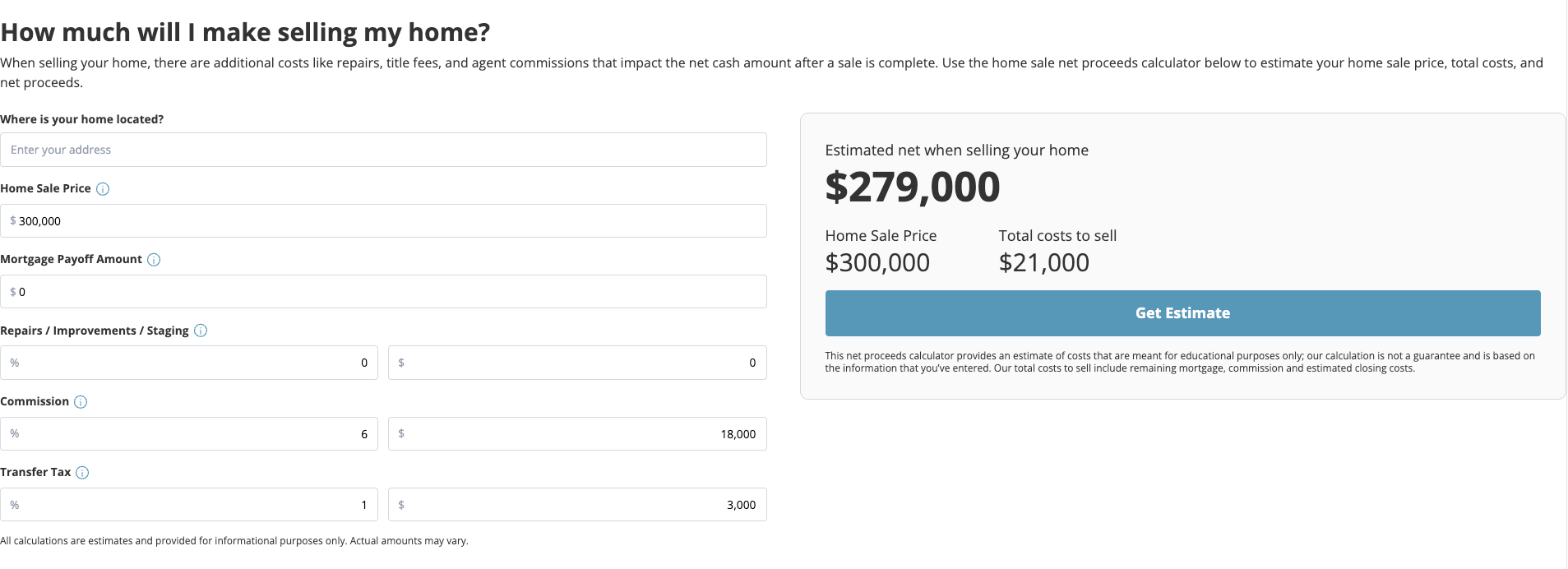
Want a more precise number? Try our Home Sale Calculator to get a better idea of your closing costs and net proceeds.
Additional Costs to Budget For Beyond Closing
Closing costs are one piece of the financial picture, but they’re not the whole thing. Meghan Heritage, owner of BlueWest Properties, walks through some of the homebuying costs that often come as a surprise after the closing statement is signed.
From moving expenses to immediate repair needs and HOA fees, the first year of homeownership tends to cost more than the closing disclosure shows. If you budget for these extras upfront, they don’t have to derail you after the keys are in hand.
Can You Negotiate Closing Costs?
Yes — and more than most buyers realize. The key is knowing which costs are fixed and which ones have room to move.
Seller concessions are one of the most effective tools for buyers. This is when the seller agrees to cover some or all of the buyer’s closing costs as part of the purchase agreement. Depending on your loan type, concessions can cover up to 3-6% of the purchase price. They don’t eliminate the fees — they just shift who writes the check. In a slower or balanced market, asking for concessions is standard.
|
Agent Insight
In the West Michigan lakeshore market (especially in Grand Haven, Spring Lake, and Muskegon), homes in desirable price ranges move quickly. In multiple-offer situations, asking for seller concessions can hurt your competitiveness. Your real estate agent can help you read the current market and decide whether to build concessions into your offer or negotiate them another way. |
Lender credits flip the equation: your lender covers your upfront closing costs in exchange for a slightly higher interest rate. This can make sense if you’re short on cash at closing and plan to sell or refinance within a few years.
Shopping third-party service providers is where many buyers leave money on the table. Title insurance, escrow fees, and settlement charges are not locked in. Getting quotes from two or three providers is your right, and it can shave hundreds off your total.
What Makes Michigan Closing Costs Different?
Michigan has a few characteristics that separate it from other states when it comes to closing costs.
Transfer Taxes are Legally the Seller’s Responsibility
Unlike many states where transfer taxes are negotiated or split, Michigan statute MCL 207.523 assigns them to the seller. The combined rate is $8.60 per $1,000 of sale price (state: $7.50/thousand, county: $1.10/thousand). On a $400,000 sale, that's $3,440 — collected by the county Register of Deeds when the deed records. This is a hard cost that shows up before commissions, and it should be in every seller's math before listing.
Attorney Involvement Is Common But Not Required
Some states mandate a real estate attorney at closing; Michigan does not. Transactions can close through a title company alone. That said, many West Michigan closings, particularly complex ones, do involve an attorney for document prep and review. Attorney fees typically run $400–$800 when they're involved.
Michigan’s Closing Costs Run Below the National Average
According to 2025 data from LodeStar Software Solutions (via Rocket Mortgage), Michigan's average closing costs are $4,138 including taxes and recording fees — 23.5% below the national average of $5,410. Buyers and sellers along the West Michigan lakeshore aren't facing the fee structures of coastal markets.
Know Your Numbers Before You Get to the Table
Closing costs don't have to be a last-minute shock. Whether you're buying your first home in Grand Haven or selling a property in Spring Lake, running your numbers early puts you in a much stronger negotiating position and keeps the final walkaway figure from catching you off guard.
Use our Home Sale Calculator to run your seller net proceeds before you list. And when you're ready to talk strategy, we’re here. Contact us online →
Frequently Asked Questions About Closing Costs
Who pays closing costs in Michigan — the buyer or the seller?
Both parties pay closing costs, but they cover different fees. By Michigan custom, sellers pay transfer taxes (required by law), owner's title insurance, the title search, and their share of settlement fees. Buyers pay lender fees, appraisal, inspection, lender's title insurance, and prepaid escrow items. Agent commissions are negotiated separately.
Can you roll closing costs into your mortgage?
Not directly on a purchase loan, but there are workarounds. With a no-closing-cost loan, your lender covers upfront fees in exchange for a higher interest rate. Seller concessions can also effectively offset your closing costs without increasing your loan balance. For refinances, costs can sometimes be rolled into the loan balance if you have enough equity.
Are closing costs negotiable?
Some are, some aren't. Transfer taxes and recording fees are set by law. Lender origination fees, underwriting fees, and title service fees are negotiable, and shopping between providers can save you real money. Seller concessions, where the seller credits the buyer for closing costs at the table, are also negotiable as part of the purchase agreement.
What’s included in closing costs?
Closing costs include lender fees (origination, underwriting, credit report), third-party fees (appraisal, inspection, title insurance, attorney or settlement fees), prepaid items (property taxes, homeowner's insurance, per diem interest), and government fees (transfer taxes, recording fees). The down payment is not a closing cost.
Are closing costs tax deductible in Michigan?
Some are. Mortgage points (prepaid interest) paid at closing are generally deductible in the year of purchase. Prepaid property taxes and mortgage interest may also be deductible. Most other fees are not. Talk to a tax professional for guidance specific to your situation; closing cost deductibility depends heavily on how you itemize.
When do you pay closing costs?
Closing costs are due on the closing day itself, paid by certified check or wire transfer before keys change hands. Your lender is required to provide a Closing Disclosure at least three business days before closing, which shows your exact amount owed.